
What is Surface Roughness Ra? Definition, Measurement & Chart
If you’ve ever run your hand over a piece of machined metal, you know that some surfaces feel silky smooth, while others feel slightly rough or textured.
In industries where cleanliness or precision is everything, just guessing how a surface "feels" isn't good enough. We need an exact, scientific way to measure it. That is where Ra comes in.
Here is a simple, no-nonsense breakdown of what surface roughness Ra actually means, how it’s measured, and why it matters.
The Basic Idea: Peaks and Valleys
To understand Ra, imagine looking at a piece of metal under a super-powerful microscope. Even if it looks perfectly flat to the naked eye, the microscope will reveal a microscopic landscape of microscopic mountains (peaks) and valleys (troughs). These are the tiny marks left behind by cutting tools, grinding wheels, or polishing compounds.
Ra stands for Roughness Average.
Think of it as taking a microscopic "slice" of that surface, measuring the heights of all the peaks and the depths of all the valleys, and calculating the average deviation from an imaginary flat center line.
- High Ra value: The peaks are tall and the valleys are deep. The surface is rough.
- Low Ra value: The peaks and valleys are incredibly tiny. The surface is smooth.
How is it Measured?
The most common way to measure Ra is with a tool called a profilometer.
Imagine a microscopic record player needle (a diamond stylus) gently dragging across the metal surface. As it rides up over the peaks and drops down into the valleys, a sensor records the movement. A computer then runs a quick math formula to find the average height of those microscopic bumps.
The measurement is typically given in:
- Micrometers (µm): Used everywhere internationally.
- Microinches (µin): Common in the United States.
Quick Conversion Rule of Thumb: 1µm is roughly equal to 40µin. So, a surface roughness of 0.8µm is the same as 32µin.
Why Do We Care So Much About Ra?
In standard manufacturing, Ra ensures parts fit together nicely or don't wear out too fast. But in specialized industries—like food processing, beverages, and pharmaceuticals—Ra is a matter of safety.
1. The Bacteria Trapping Point (Ra < 0.8µm)
In hygienic design, the magic number is almost always Ra <0.8µm (32µin).
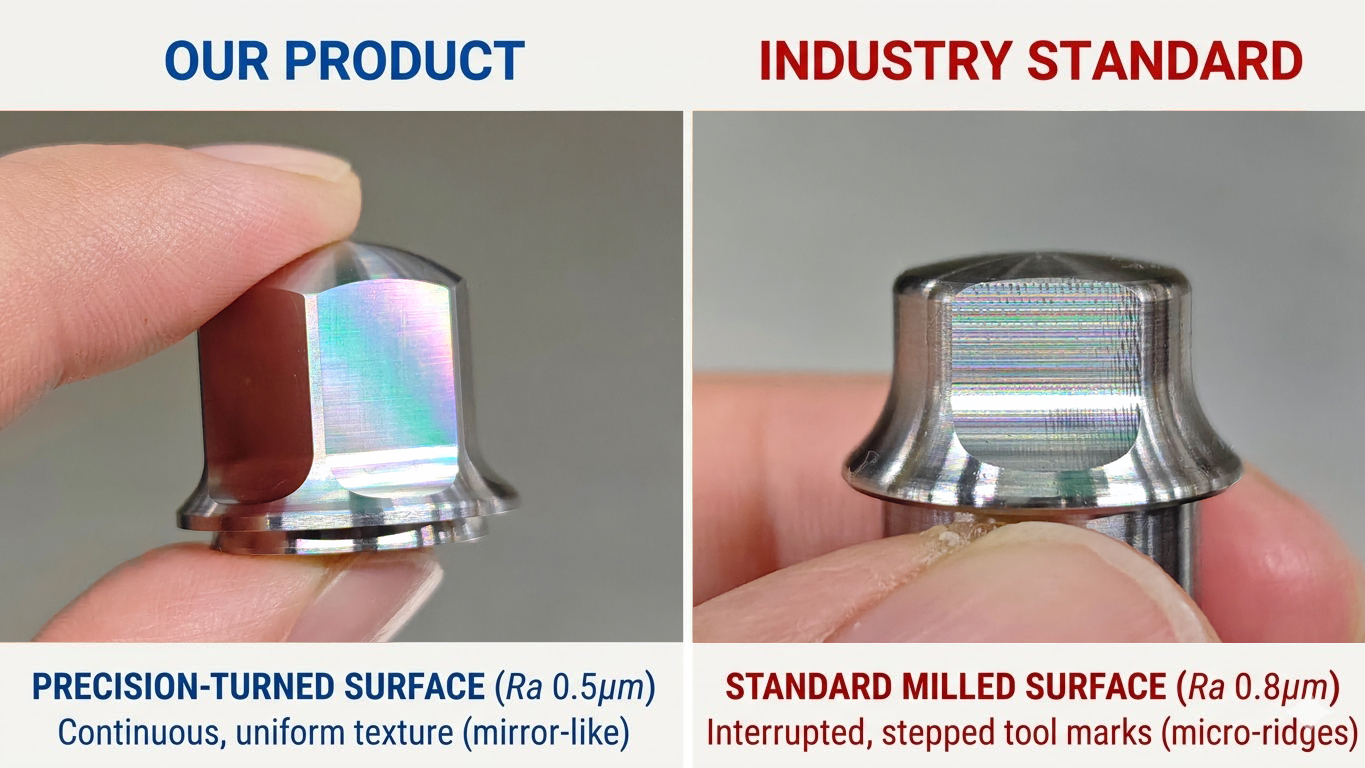
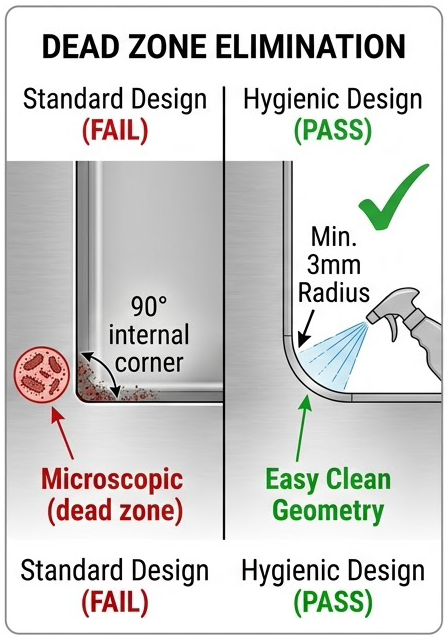
Why? Because bacteria like Salmonella or Listeria are tiny—often only 1 to 2 micrometers size. If a metal surface has an Ra higher than 0.8µm, the microscopic valleys are deep enough for bacteria to hide inside them. Once bacteria wedge themselves into those valleys, normal cleaning sprays and sanitizers can't reach them. Over time, they form a "biofilm" and contaminate the product.
2. Ease of Cleaning
When a surface is ultra-smooth (like Ra < 0.4µm), liquids and food particles slide right off. During a Clean-in-Place (CIP) cycle, the cleaning chemicals can easily flush away everything, saving factories time, water, and expensive chemicals.
3. Friction and Wear
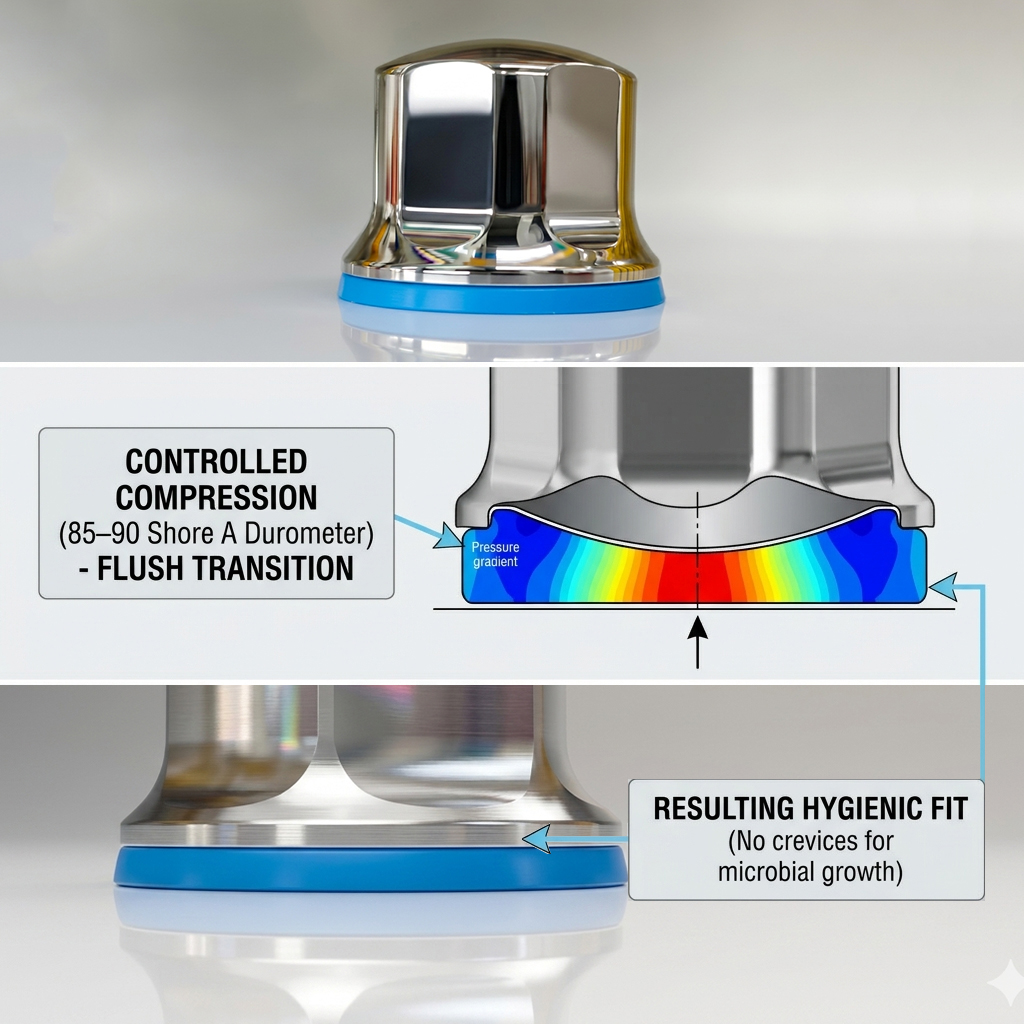
In moving parts, like seals or valves, a surface that is too rough will grind away at rubber gaskets and O-rings, causing them to tear and fail prematurely.
How Do We Achieve Low Ra Values?
Getting a piece of metal down to a low Ra value requires careful manufacturing steps:
- CNC Turning and Milling: Precision machining can get surfaces quite smooth, but it often leaves fine tool marks.
- Mechanical Polishing: Using progressively finer abrasives or belts to buff out the machining marks.
- Electropolishing: A chemical-electrical bath that literally dissolves the microscopic "peaks" off the metal, leaving a mirror-like, ultra-hygienic finish.
Surface Roughness (Ra) Chart by Manufacturing Process
The table below outlines typical surface roughness ranges achieved by common manufacturing and finishing methods. While tighter tolerances are possible with specialized equipment, these represent standard industrial capabilities.
| Manufacturing Process | Ra Range in Micrometers (µm) | Ra Range in Microinches (µin) | Typical Cleanability / Hygiene Suitability |
| Flame Cutting | 6.3 to 25.0 | 250 to 1000 | Non-hygienic; rough industrial use only |
| Sand Casting | 5.0 to 12.5 | 200 to 500 | Non-hygienic; raw structural parts |
| Standard Milling / Turning | 1.6 to 6.3 | 63 to 250 | Standard mechanical fit; prone to trapping bacteria |
| Precision Milling / Turning | 0.4 to 1.6 | 16 to 63 | Industrial parts; higher end borders food-safe |
| Grinding | 0.2 to 1.6 | 8 to 63 | Smooth mechanical surfaces; entry-level sanitary |
| Mechanical Polishing | 0.1 to 0.8 | 4 to 32 | Excellent; Meets standard sanitary requirements (<0.8 µm) |
| Lapping / Honing | 0.05 to 0.4 | 2 to 16 | High-precision seals, liquid-tight valves |
| Electropolishing | 0.05 to 0.2 | 2 to 8 | Ultra-Hygienic; Mirror finish preferred for pharma/biotech |
Summary
Surface roughness Ra is simply the average height of the microscopic bumps on a surface. The smaller the number, the smoother the metal, and the harder it is for dirt and bacteria to stick to it. Keeping an eye on that tiny number is what keeps our food safe and our machinery running perfectly.